

What Is E-E-A-T in SEO? Complete Guide
Google is continuously improving how it evaluates website content to provide users with helpful, reliable, and trustworthy information. Publishing blogs with keywords alone is no longer a complete SEO strategy. Websites also need to demonstrate real experience, subject knowledge, authority, and trust.
Google recommends creating helpful, reliable and people-first content that prioritises the needs of users through its helpful and people-first content guidelines.
This is where E-E-A-T in SEO becomes important. E-E-A-T stands for Experience, Expertise, Authoritativeness, and Trustworthiness. It is a framework used in Google's Search Quality Rater Guidelines to evaluate the quality and reliability of content.
For website owners, bloggers, digital marketers, and SEO professionals, understanding E-E-A-T can help create better content and build long-term website credibility.
In this complete guide, we will explain what E-E-A-T means, how its four elements work, why trust matters, and how you can implement practical E-E-A-T SEO strategies to improve your website's content quality.
What Is E-E-A-T in SEO?
E-E-A-T in SEO refers to four important qualities that help demonstrate the credibility and reliability of website content:
Google introduced the additional Experience element in December 2022, expanding the earlier E-A-T concept into E-E-A-T.
You can read Google's explanation of the additional Experience element in its E-E-A-T guidelines update.
It is important to understand that E-E-A-T is not a single direct ranking factor or a numerical score that Google assigns to every website. Instead, Google's automated ranking systems use multiple signals to identify helpful and reliable content.
Trust is the most important element of E-E-A-T, while experience, expertise and authoritativeness contribute to establishing that trust.
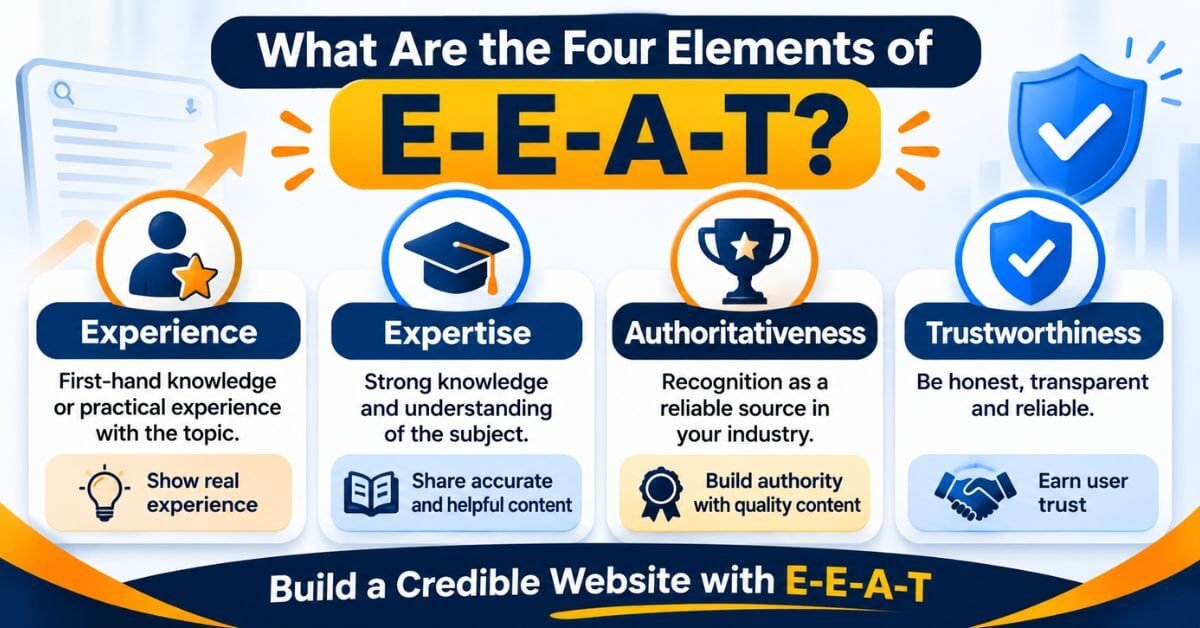
What Are the Four Elements of E-E-A-T?
Experience refers to the firsthand knowledge a content creator gains by actually performing an activity, using a product, or working in a particular industry.
For example, someone writing about SEO should ideally demonstrate practical experience with website optimization, keyword research, Google Search Console, and SEO campaigns.
1. Helps You Create Relevant Content
When you understand what users want, you can create content that directly answers their questions.
For example, a person searching for "how to improve website SEO" expects a step-by-step guide rather than a page selling SEO services.
This makes content more useful because readers can understand how strategies work in real situations.
Practical SEO Tip: Include original screenshots, genuine case studies, implementation steps, and real observations wherever relevant. Never invent results or experiences.
2. Expertise—Show Your Subject Knowledge
Expertise means demonstrating a strong understanding of the subject you are discussing.
A website should provide accurate, detailed, and useful information that answers visitors' questions.
For example, an SEO training website should not only define keyword research but also explain search intent, keyword selection, competition analysis, and practical implementation.
3. Authoritativeness—Build Recognition in Your Industry
Authoritativeness refers to the reputation and recognition of a content creator, website, or organization within its subject area.
A website becomes more credible when other relevant and trustworthy sources recognise its knowledge and contribution.
For example, a digital marketing website can build authority by consistently publishing useful SEO guides, practical tutorials, industry research, and original case studies.
4. Trustworthiness—Make Your Website Reliable
Trustworthiness is the most important element of E-E-A-T.
Visitors should feel confident that your website provides accurate information and represents your business honestly.
A trustworthy website should clearly communicate who operates it, who creates its content, and how visitors can contact the organization.
Avoid misleading claims, fabricated credentials, and unsupported promises.
A website that communicates transparently gives visitors stronger reasons to trust its information and business.
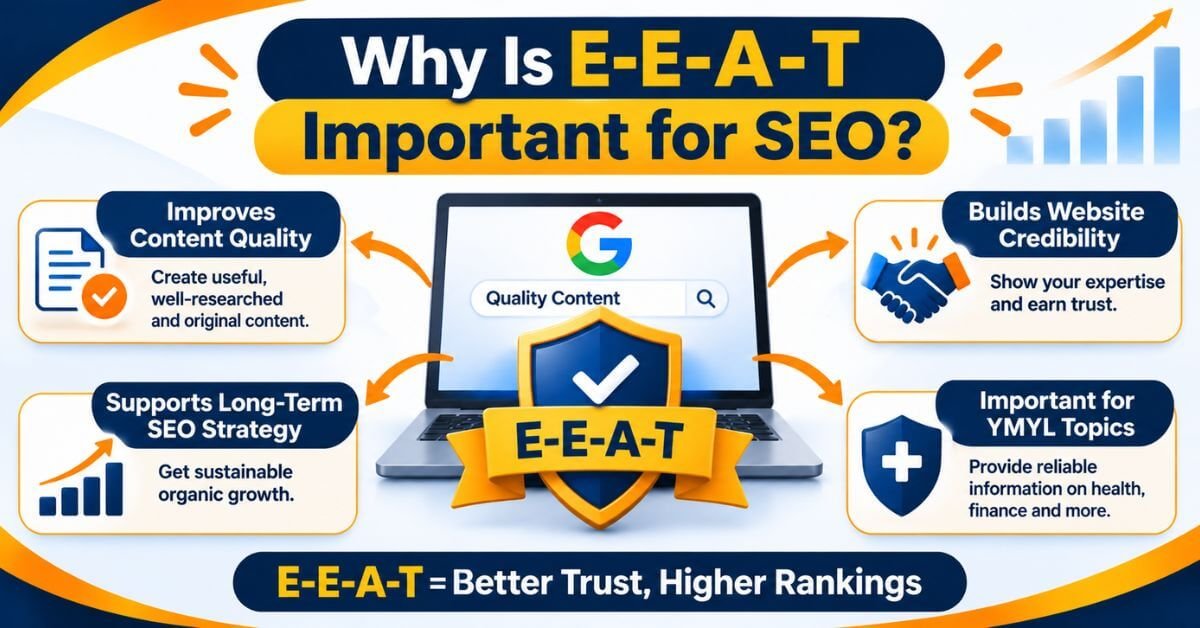
Why Is E-E-A-T Important for SEO?
E-E-A-T helps website owners understand what makes content useful, credible, and reliable.
Google aims to provide helpful results that satisfy users' search requirements. Therefore, creating original, accurate, and experience-based content is an important part of a sustainable SEO strategy.
1. Improves Content Quality
2. Builds Website Credibility
3. Supports Long-Term SEO Strategy
E-E-A-T encourages websites to focus on original, people-first content instead of publishing large numbers of low-value articles simply to attract search traffic.
4. Important for YMYL Topics
YMYL stands for Your Money or Your Life. These topics can significantly affect a person's health, financial stability, safety, or well-being.
Examples include medical advice, financial guidance, and important legal information.
Google's quality evaluation places particular importance on strong E-E-A-T for these topics because inaccurate information can have serious consequences.
Google's Search Quality Rater Guidelines explain how quality raters evaluate the quality and trustworthiness of search results, including YMYL content.
How to Improve E-E-A-T on Your Website?
Now that you understand the four elements, let's discuss practical steps to implement E-E-A-T across your website.
1. Create an Author Bio Page
2. Publish Original and Experience-Based Content
Avoid publishing articles that only rewrite information from other websites.
Add your own observations, practical examples, screenshots, and implementation experience.
For example, when writing about Google Search Console, explain how to identify impressions, clicks, CTR, and average position using actual reports.
This approach makes your content more informative and demonstrates genuine practical knowledge.
Understanding search intent in SEO helps you create content that matches what users actually want to learn when they search on Google.
3. Use Reliable External References
Support important statements with trustworthy sources.
For SEO-related topics, Google Search Central is an excellent primary reference.
You can link to official documentation, industry research, and relevant authoritative resources.
However, external links should support the information being discussed rather than being added just to increase the number of outbound links.
4. Update Old Content Regularly
Do not change the publication date just to make old content appear new. Update it when meaningful changes have actually been made.
5. Build Relevant Website Authority
Create a clear content structure around your main industry topics.
For example, a digital marketing academy can publish related content on:
Connect related articles using descriptive internal links. This helps visitors discover additional information and makes your website structure easier to understand.
Before building website authority, evaluate your website's existing performance and identify improvement opportunities through a detailed SEO audit process.
6. Improve Website Transparency and Security
Make important business information easy to find.
Your website should include an About page, a Contact page, a Privacy Policy, and relevant business information.
Use HTTPS and ensure that important pages work correctly on mobile devices.
Also review broken links, indexing problems, and unnecessary redirects as part of your technical SEO maintenance.
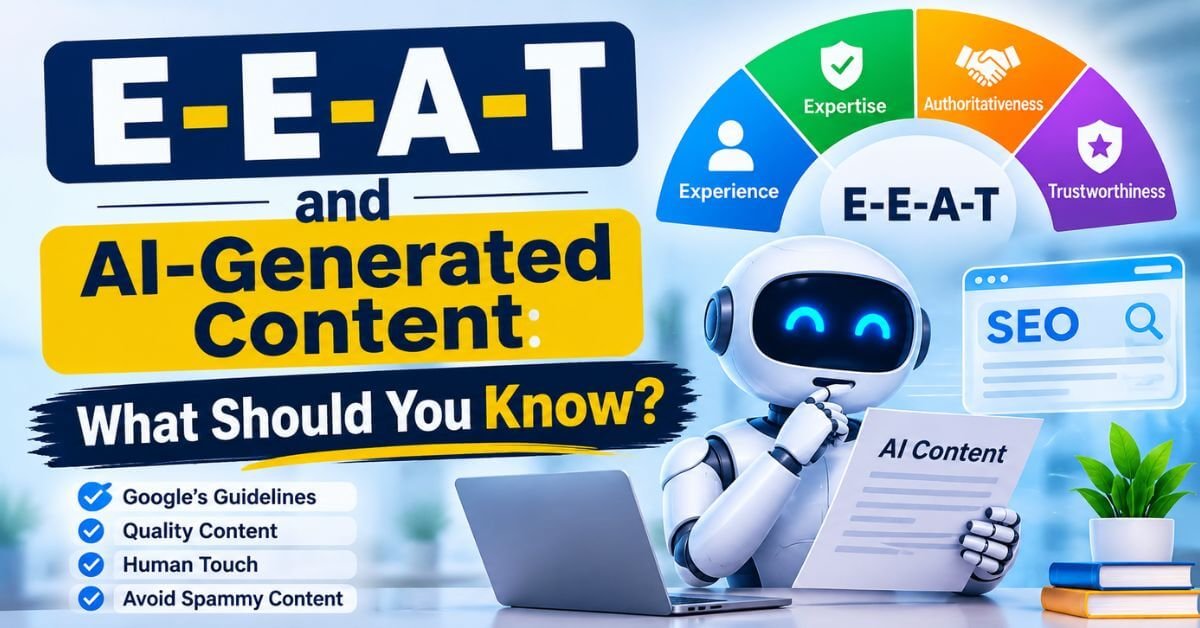
E-E-A-T and AI-Generated Content: What Should You Know?
AI tools can help digital marketers research topics, organise information, and improve writing efficiency. However, publishing AI-generated content without proper review, original insights or factual verification can create quality problems.
Google does not automatically consider AI-generated content low quality. Its guidance focuses on the usefulness, originality, and reliability of the final content.
The objective should be to use AI as a productivity tool, not as a replacement for genuine knowledge and editorial responsibility.
How to Check E-E-A-T on Your Website?
Google does not provide a dedicated E-E-A-T score inside Google Search Console or Google Analytics.
However, you can review your website using a practical evaluation checklist.
You can also use Google Search Console to monitor organic performance.
Review impressions, clicks, CTR, average position, and individual page performance to identify content that needs improvement.
Remember that these performance metrics do not directly measure E-E-A-T. They help you understand how your content performs in Google Search.
Common E-E-A-T Mistakes to Avoid
Final Thoughts
E-E-A-T in SEO is about creating a website that people can trust and content that genuinely helps visitors.
Experience demonstrates practical knowledge, expertise establishes subject understanding, authoritativeness builds industry recognition, and trustworthiness gives visitors confidence in the information they read.
For sustainable SEO growth, focus on original content, genuine author experience, accurate information, useful internal links and a transparent website structure.
At KishorDigital, we believe that practical implementation and real industry experience are essential for understanding digital marketing. The same principle applies to SEO content: demonstrate what you know, explain what you have done and provide information that helps readers achieve their goals.
Remember: Build content for people first, demonstrate real experience and make trust the foundation of your website.
If you want to develop practical SEO and digital marketing skills, explore our practical digital marketing training programs and learn industry-relevant techniques through hands-on implementation.
Whether you need more leads, better online visibility or a complete digital marketing solution, our team is here to understand your goals and suggest the right approach for your business. Get in touch with KishorDigital today and let’s turn your digital goals into measurable results.
Frequently Asked Questions (FAQs)
E-E-A-T stands for Experience, Expertise, Authoritativeness, and Trustworthiness. It is a framework used in Google's Search Quality Rater Guidelines to evaluate the quality and reliability of online content.
No. E-E-A-T itself is not a specific direct Google ranking factor or score. However, Google uses multiple signals to identify content that demonstrates qualities associated with E-E-A-T.
The four components are Experience, Expertise, Authoritativeness, and Trustworthiness. Together, they help evaluate the reliability and quality of website content.
E-E-A-T encourages websites to publish accurate, helpful, and experience-based content. It is particularly important for topics that can affect people's health, finances, and safety.
You can improve your website's E-E-A-T by publishing original content, adding genuine author biographies, sharing practical experience, earning relevant backlinks and maintaining transparent business information.
AI-generated content is not automatically considered low quality. The important factors are originality, accuracy, usefulness, and whether the content provides genuine value to readers.
E-A-T stands for Expertise, Authoritativeness, and Trustworthiness. Google added another E for Experience in December 2022 to recognise the importance of first-hand knowledge.
New websites can demonstrate E-E-A-T through original content, genuine author information, accurate references, and practical knowledge. However, demonstrating these qualities does not guarantee higher rankings.